People — Counselor in the Presidency
Sidney Rigdon
A Reformed Baptist preacher in Ohio who joined the church in November 1830, became Joseph Smith’s scribe and counselor, and in May 1834 moved to change the church’s name.
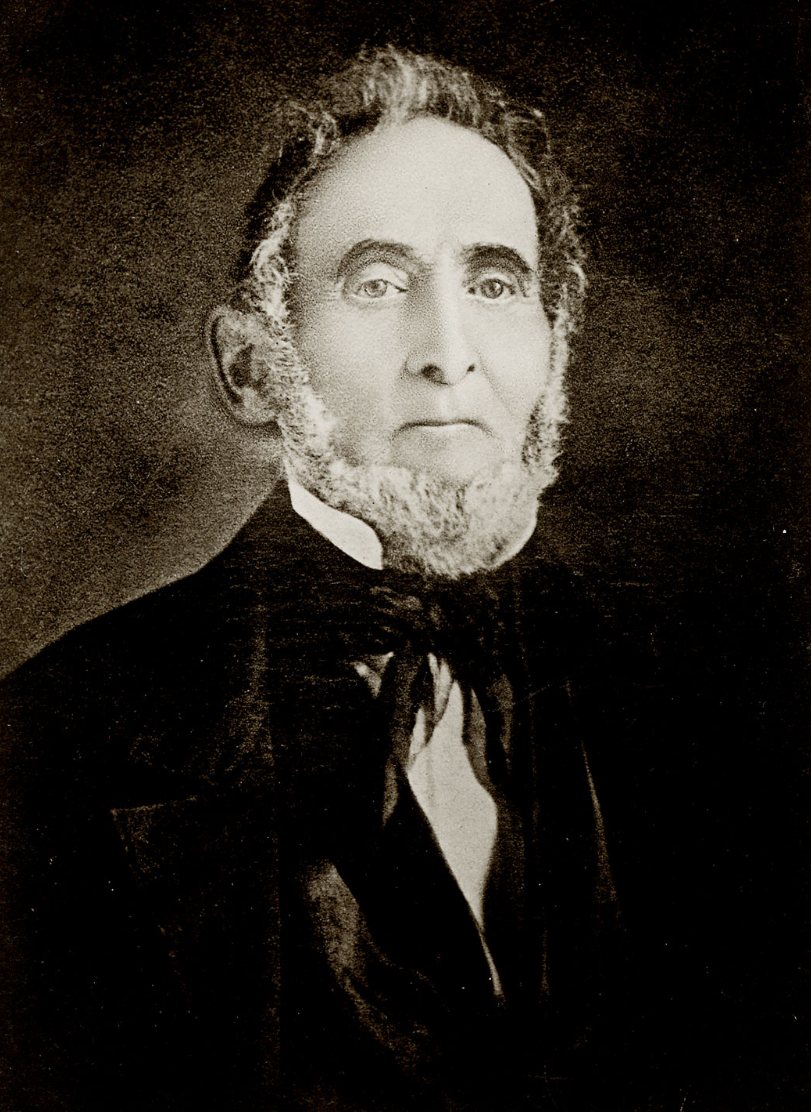
Sidney Rigdon (1793–1876) was already an influential preacher in northeastern Ohio when the Book of Mormon reached him in 1830. His conversion brought a body of believers into the church at once, and within two years he was a counselor in its presidency.
Background
Born 19 February 1793 at St. Clair, Allegheny County, Pennsylvania. A Baptist minister, including at the First Baptist Church of Pittsburgh from 1821 to 1824, he later joined the Reformed Baptist (Campbellite) movement and settled at Mentor, Ohio, in 1827.
1830
Introduced to the Book of Mormon by his former convert Parley P. Pratt, who was traveling west with Oliver Cowdery. Baptized by Cowdery in November. In December he traveled with Edward Partridge to meet Joseph Smith in New York, and served as his scribe.
1831
Ordained a high priest at Kirtland on 4 June, and went to Missouri that summer. Moved to Hiram, Ohio, and in November was appointed to what became the Literary Firm.
1832
Called as a counselor in the presidency in March, and attacked by a mob alongside Joseph Smith at Hiram on 24 March. Appointed to the United Firm in April.
1833
Attended the organizing meeting of the School of the Prophets in January, and from March served in the presidency with Frederick G. Williams. In the autumn he accompanied Joseph Smith to Upper Canada and helped keep his diary on the journey.
1834
Sat in the presidency when the Kirtland high council was organized in February. At the conference of 3 May he proposed the motion changing the church’s name, and he remained in Kirtland when Zion’s Camp left for Missouri.
Reading the record
Rigdon brought to the church the experience of a minister who had already broken with one denomination over questions of primitive Christianity. The record places him at the points where the church defined itself in words: as a scribe of revelations, as a member of the Literary Firm that published them, and as the author of the 1834 motion that gave the church a new name.
After 1834
He remained a counselor in the presidency until 1844, when his claim to lead the church after Joseph Smith’s death led to his excommunication. That later history lies beyond this site’s period. The Joseph Smith Papers biography covers the rest of his life.
Biographical details follow the biographical entry for Sidney Rigdon in the Joseph Smith Papers, checked against the dated documents cited on this site’s chronology pages. This page links out to primary sources rather than reproducing them at length.