People — First Elder and President
Joseph Smith Jr.
The church’s First Elder from April 1830 and President of the High Priesthood from January 1832, and the person through whom the revelations this site indexes were received.
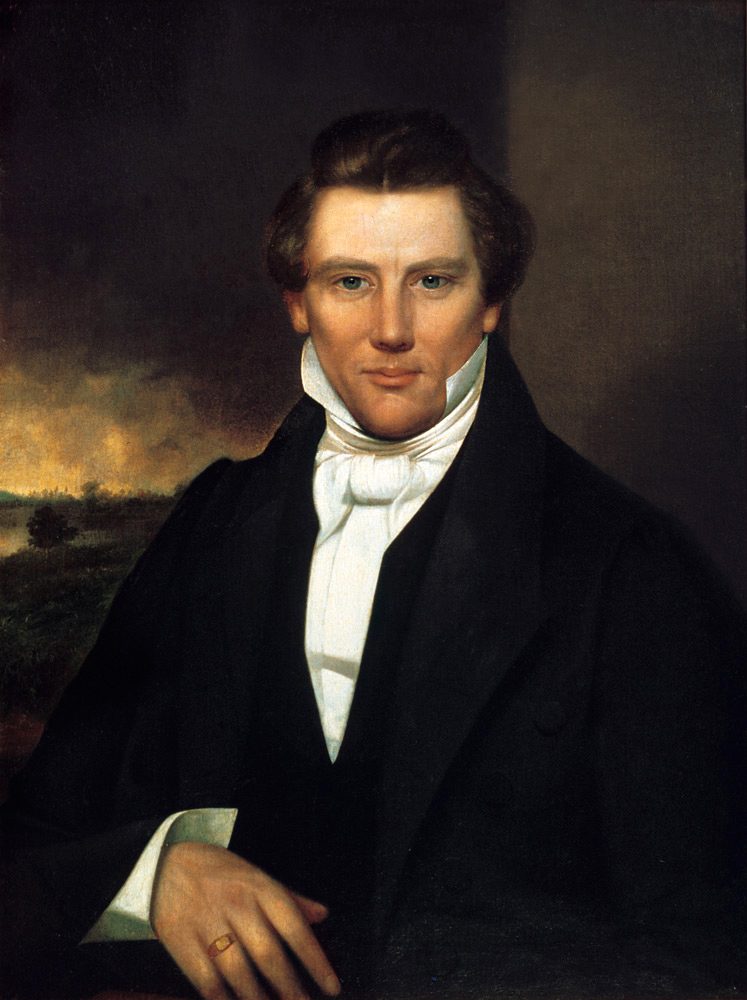
Joseph Smith Jr. (1805–1844) appears on nearly every page of this site, most often as the recipient of a revelation or the presiding officer at a conference. This page gathers his roles between 1829 and May 1834 in one place, following the dated record rather than later accounts of his life.
Background
Born 23 December 1805 at Sharon, Windsor County, Vermont, to Joseph Smith Sr. and Lucy Mack. Married Emma Hale in January 1827.
1829
Dictated the translation of the Book of Mormon, with Oliver Cowdery as principal scribe from April, and completed it at the Whitmer home in Fayette, New York, in June. Baptized with Cowdery in May. Secured the book’s copyright on 11 June.
1830
The Book of Mormon went on sale at Palmyra in March. From the church’s organization on 6 April, he and Cowdery served as First and Second Elder, and the Articles and Covenants were accepted at the first conference in June.
1831
Moved to Kirtland, Ohio, early in the year, where the Law of the Church was received on 9 February. In the summer he traveled to Missouri, where Independence was designated the center place of Zion. From September he lived at Hiram, Ohio.
1832
Ordained President of the High Priesthood at a conference in Amherst, Ohio, on 25 January. Called Jesse Gause and Sidney Rigdon as counselors in March, and was attacked by a mob at Hiram on the night of 24 March. In April, on a second visit to Missouri, the United Firm was organized.
1833
Organized the School of the Prophets at Kirtland in January. From March he presided with Sidney Rigdon and Frederick G. Williams as counselors. The plat of the city of Zion and the plan of the house were prepared in June. Traveled to Upper Canada in October.
1834
Presided at the organization of the Kirtland high council on 17 February, and received the revelation of 24 February that led to Zion’s Camp. Acted as moderator at the 3 May conference that renamed the church, and left Kirtland with the camp in early May.
Reading the record
Across these six years the record shows his authority taking institutional form in stages: an elder among elders in 1830, ordained to preside over the high priesthood in 1832, presiding with counselors from 1833, and over a standing council from 1834. Each step was taken at a conference or council and written into minutes, which is the record this site follows.
After 1834
His later life, including the move to Missouri in 1838 and his death at Carthage, Illinois, in June 1844, lies beyond this site’s period. The Joseph Smith Papers biography covers the rest of his life.
Biographical details follow the biographical entry for Joseph Smith Jr. in the Joseph Smith Papers, checked against the dated documents cited on this site’s chronology pages. This page links out to primary sources rather than reproducing them at length.