Chronology — 1834
1834: A Council, a Camp and a Name
Four months, from a standing council in February to a new name in May, in which the church rebuilt its government, divided its firm and raised a company to restore Zion.
The year in which this site’s record ends is a short one: it closes on May 3, 1834, when a conference of elders in Kirtland voted to change the church’s name. The four months before that vote nonetheless changed more of the church’s structure than any comparable stretch since 1830. A standing high council was created, the United Firm was broken up, and an expedition was recruited to restore the members driven from Jackson County.
January: Debts and refugees
The year opened under two burdens carried over from 1833. The Missouri members, expelled from Jackson County in November, were refugees, most of them across the river in Clay County; their account of the expulsion was printed in an extra edition of The Evening and the Morning Star in February. In Kirtland, the United Firm still owed debts for stores and a press that no longer operated, and in January Joseph Smith and other members of the firm prayed for the means to pay everything it owed.
February 17–19: A standing council
On February 17 a council of high priests at Joseph Smith’s house organized the church’s first standing high council, twelve counselors with Joseph Smith, Sidney Rigdon and Frederick G. Williams as presidents. Two days later its revised minutes were accepted as its constitution, and it heard its first case. The council’s membership and procedure are set out in The High Council of 1834.
February 24: A call to redeem Zion
A week later Parley P. Pratt and Lyman Wight arrived from Missouri and reported to the new council on the refugees’ condition, asking how Zion was to be redeemed. Joseph Smith volunteered to lead an expedition; thirty or forty others said they would go; and the council named him commander in chief of the armies of Israel.
A revelation of the same day directed him to gather the strength of the Lord’s house, the young and middle-aged men, to go up to Zion: five hundred if they could be found, three hundred if not, and no fewer than one hundred before setting out. It paired the recruiters, Pratt with Joseph Smith, Wight with Sidney Rigdon, Hyrum Smith with Frederick G. Williams, and Orson Hyde with Orson Pratt, and directed the branches to send wise men with money to buy land.
The recruiters left within days, Joseph Smith and Pratt on February 26 and Wight and Rigdon about February 28, and spent March and April preaching, gathering volunteers and raising money among the branches in New York and Ohio. In March Joseph Smith also asked members in New York to raise two thousand dollars for the relief of Kirtland.
April: The firm divided
Money stayed short, and Joseph Smith feared he could not leave Ohio with the firm’s debts unpaid. On April 10 the Kirtland members of the United Firm decided to dissolve it. A revelation of April 23 assigned each of them a stewardship, separated the Kirtland firm from its partners in Missouri, and allowed the properties to be pledged, once, to pay creditors. The details are in The United Firm, 1832–1834.
May 3: A new name
On May 3, 1834, a conference of elders at Kirtland voted to change the church’s name, on a motion by Sidney Rigdon seconded by Newel K. Whitney. The name the church had borne since its organization on April 6, 1830, the name this site uses throughout, ended there, and with it the period this study covers. The vote and its background are examined in The 1834 Name Change.
After May: The camp sets out
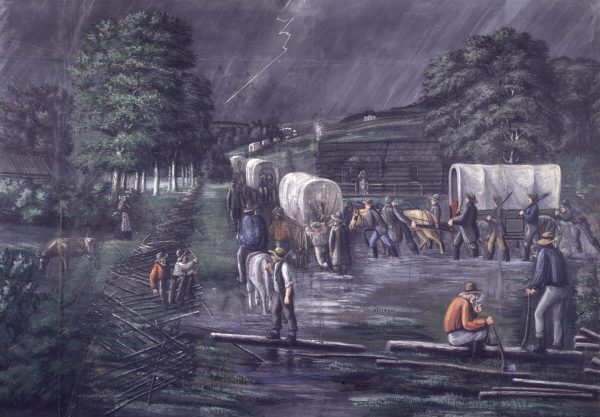
Within days the expedition began leaving Kirtland. Joseph Smith was away from early May until late July, and more than two hundred people eventually marched to Clay County, Missouri, as the Camp of Israel, later remembered as Zion’s Camp. Its outcome, a revelation at Fishing River on June 22, 1834, and the camp’s disbanding without the restoration it had set out to achieve, lies just beyond this site’s period. So does the second standing high council, organized in Clay County that July on the Kirtland pattern.
Reading the record
Read in sequence, the first months of 1834 are the point at which the church’s institutions caught up with its circumstances. The firm built for a church centered on Independence could not survive the loss of Independence; a council built for a larger church, with more members and more disputes, took up much of its work; and the call to redeem Zion came not through the bishop or the firm but through that new council. The renaming in May closes this site’s record at a moment when the church had remade much of its structure, weeks before setting out to recover the city its plat had been drawn for.
Primary sources: Joseph Smith Papers, “Minutes, 17 February 1834”; “Minutes, 19 February 1834”; “Minutes, 24 February 1834”; “Revelation, 24 February 1834 [D&C 103]”; “Revelation, 23 April 1834 [D&C 104]”; historical introductions to D&C 102, D&C 103 and D&C 104 in Joseph Smith’s Revelations: A Doctrine and Covenants Study Companion (2020). This page links out to primary sources rather than reproducing them at length.