Publications — 1833
The Book of Commandments, 1833
The first attempt to print the church’s revelations as a book: authorized in Ohio, typeset in Missouri, and stopped by a mob with 160 pages printed.
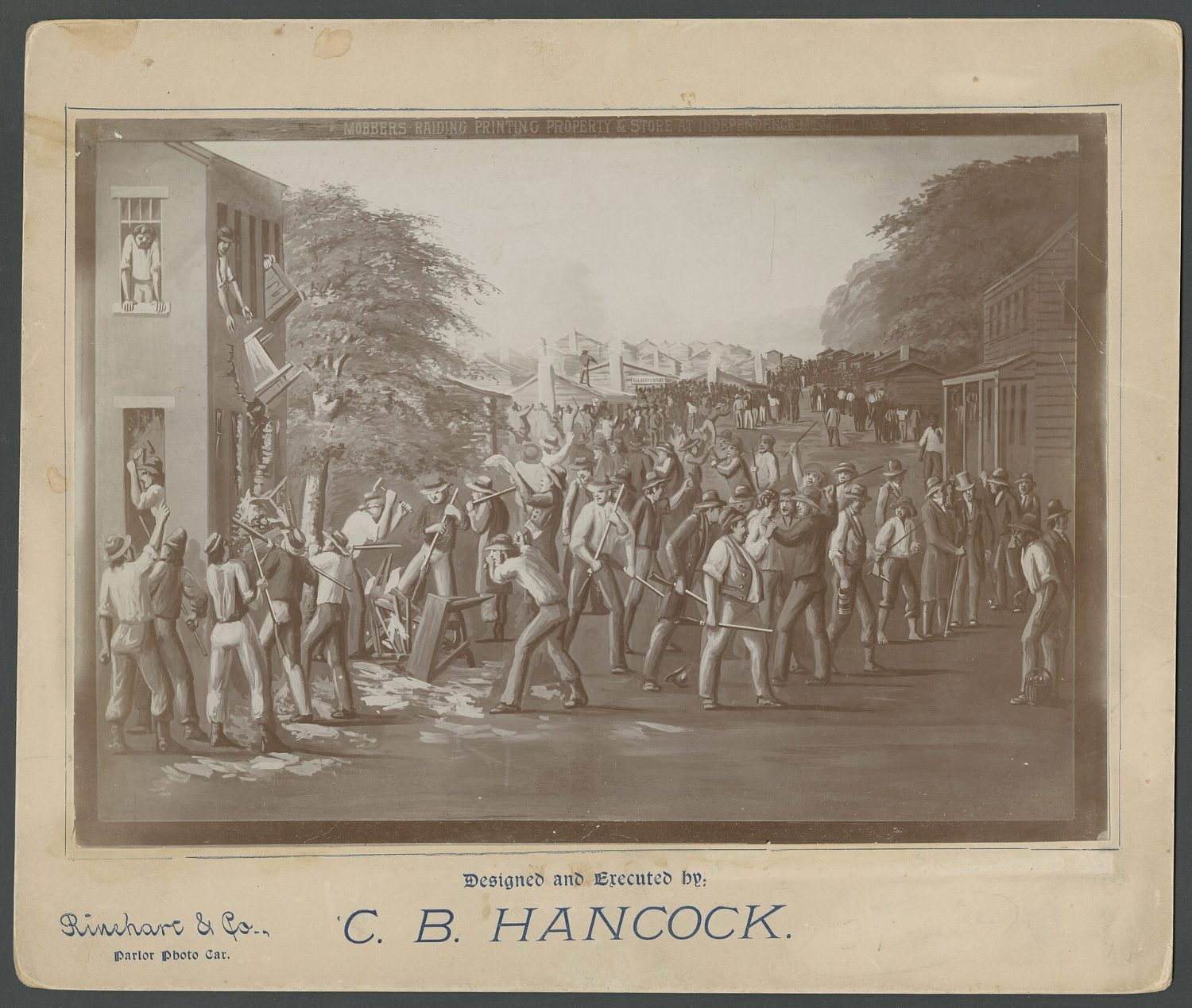
For its first two years, the church’s revelations existed only in manuscript, in the record books its clerks kept and in the copies elders made for themselves. On November 1, 1831, a conference of elders at Hiram, Ohio, voted to change that, authorizing ten thousand copies of a printed compilation. Twenty months later, with five gatherings of the book printed, a mob destroyed the press. What survives of that edition is the Book of Commandments.
From manuscript to print
Early revelations had urged restraint; one from about the summer of 1829 told its readers not to show its contents to the world, and copying by hand kept the texts within a small circle. The November 1831 conference reversed that. A revelation given just after it described the commandments as once kept from the world and now to go forth to all, and another, dated November 1, was designated the book’s preface and placed first.
A revelation of November 12, 1831, appointed stewards over the revelations, soon known as the Literary Firm, with the United Firm providing financial support. Oliver Cowdery and John Whitmer carried the manuscript book now called Revelation Book 1 from Kirtland to Independence, Missouri, setting out on November 20, 1831. There W. W. Phelps, appointed church printer the previous July, set the type, using Revelation Book 1 as his main source. A council in Missouri in the spring of 1832 reduced the planned printing to three thousand copies.
The book and the newspaper
The same shop began issuing The Evening and the Morning Star in June 1832, a paper devoted to the revelations. Its first issue opened with the Articles and Covenants, and by June 1833 twenty-six full or partial revelation texts had appeared in its pages, reaching perhaps a few hundred subscribers. Type passed in both directions: some revelations were set for the book from their newspaper versions, and some newspaper texts from the book’s type.
The book’s title was A Book of Commandments, for the Government of the Church of Christ, Organized according to Law, on the 6th of April, 1830, with the imprint Zion: W. W. Phelps & Co., 1833. The title states its purpose: these were texts for governing the church. Missionaries took orders in advance; in 1832 Orson Hyde collected some from new converts in Massachusetts who had never seen the book.
July 20, 1833
Tension between the Missouri Saints and their Jackson County neighbors broke in July 1833. On July 20 a mob destroyed Phelps’s printing office and demanded that the Saints leave the county (see 1833). Printing stopped mid-book. Five gatherings of sixteen leaves had been printed, 160 small pages about four and a half by three inches, holding sixty-five chapters, the last of them, the revelation of September 11, 1831, broken off mid-text. More revelations had been planned for the volume.
Some printed sheets were saved. Later tradition credits two girls in Independence, Mary Elizabeth and Caroline Rollins, with gathering sheets from the street. Surviving copies were folded and bound privately, in Missouri and in Kirtland, so no two are quite alike, and the title page is known in more than one setting. The book was put to use: Orson Pratt read from it at a baptismal meeting in 1834, and Phelps counseled his wife from one of its revelations in 1835.
What the book preserves
Because it was set from Revelation Book 1 in 1832 and 1833, the Book of Commandments preserves the revelations much as the church first used them, before the revisions made for the 1835 Doctrine and Covenants. Its chapter 24, the Articles and Covenants, carries a date, June 1830, found in no other version. Its revelations name offices and arrangements as they stood when they were given; the 1835 edition updated some of them to describe offices, among them high priest, bishop and high counselor, that were established later. For a study of the church as it was organized between 1829 and 1834, the 1833 text is the nearer witness.
Reading a Book of Commandments chapter beside its 1835 section is often the quickest way to see what changed in the church between 1831 and 1835.
After the press
Within two months the firm’s leaders set up a new press in Kirtland under F. G. Williams & Co., which resumed the newspaper and, by an April 1834 revelation, took charge of printing the revelations. In September 1834 a committee of Joseph Smith, Sidney Rigdon, Oliver Cowdery and Frederick G. Williams began compiling a successor volume from the manuscript revelation books and the Book of Commandments. It appeared in 1835 as the Doctrine and Covenants, approved by a general assembly on August 17, 1835, as “a law unto the church, and a rule of faith and practice.”
Reading the record
The Book of Commandments is the record of a church that decided, in November 1831, that its government should rest on printed revelation, and of how far that plan had got when it met the events of 1833. Its 160 pages are a fixed point in this site’s sources: whatever later editions say, this is the text as typeset in Independence before the expulsion.
Primary sources: Joseph Smith Papers, “Book of Commandments, 1833”; “Publishing the Revelations”; “Joseph Smith–Era Publications of Revelations,” appendix 2 in Joseph Smith’s Revelations: A Doctrine and Covenants Study Companion (2020). This page links out to primary sources rather than reproducing them at length.