Institutions — 1832–1834
The United Firm, 1832–1834
A covenant partnership of eleven men that ran the church’s stores, presses and land purchases for two years, and whose revelations were kept out of print until it no longer existed.
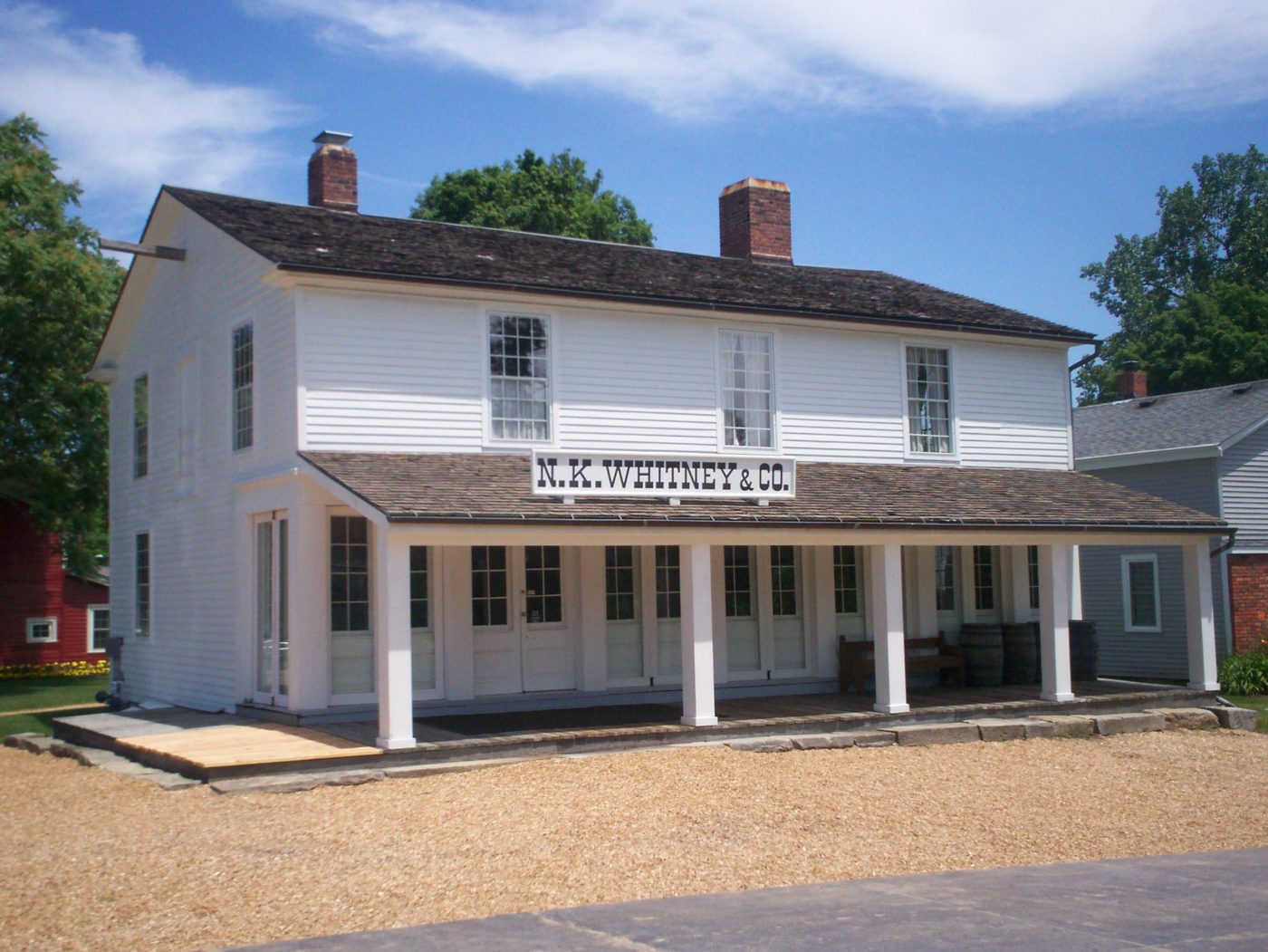
Between April 1832 and April 1834, the business side of the Church of Christ was run neither by its bishops alone nor by its conferences, but by a firm. Bound to one another by covenant and by a legal bond, its members held the church’s stores, printing offices and land purchases in Ohio and Missouri, and drew on each other’s resources to keep them going. Its name, the United Firm, appears in the manuscript revelations of the period but was replaced when those revelations were finally printed.
Origins: March and April 1832
The first revelation on the subject, dated March 1, 1832, directed that the church’s publishing and mercantile concerns be organized by an everlasting covenant that could not be broken, on pain of losing office and standing in the church. The members were named the following month, at a council of high priests and elders held in Independence, Missouri, on April 26–27, 1832. The revelation given there also acknowledged the reconciliation of Sidney Rigdon and the Missouri bishop, Edward Partridge, after an earlier quarrel, and described Kirtland as a “stake” to Zion: a place that would support Zion rather than a temporary halt on the way to it.
The members
Nine men were named in April 1832, five living in Missouri and four in Ohio:
- Missouri: Edward Partridge, bishop; Sidney Gilbert, agent and keeper of the storehouse; Oliver Cowdery; John Whitmer; and W. W. Phelps, the church printer.
- Ohio: Joseph Smith; Sidney Rigdon; Newel K. Whitney, bishop in Ohio; and Martin Harris.
Frederick G. Williams was added in March 1833 and John Johnson in June 1833, making eleven. Every one of the original nine already held a stewardship of some kind. Six of them, Joseph Smith, Rigdon, Cowdery, Whitmer, Harris and Phelps, had been appointed stewards over the revelations in November 1831, the group known as the Literary Firm; Partridge and Whitney were bishops; Gilbert ran the storehouse in Missouri. Jesse Gause, then a counselor to Joseph Smith, was not made a member, perhaps because he had no part in the church’s publishing or trade.
How it worked
The April 1832 revelation made the members equal in their claims on the firm’s properties, each according to his wants and needs so far as they were just, with any surplus, the “talents” gained by improving their stewardships, to go into the Lord’s storehouse as the common property of the church. It was to be done according to the laws of the land: Phelps and Gilbert were assigned to draft a legal bond, and the members became jointly responsible for the firm’s debts.
In practice the firm had three parts. N. K. Whitney & Co., the store Whitney and Gilbert had run in Kirtland since 1826, was its mercantile house in Ohio. Gilbert, Whitney & Co., formed after Gilbert moved to Missouri in early 1832, ran his store in Independence. The Literary Firm oversaw the church’s printing: W. W. Phelps & Co. in Missouri and, from September 1833, F. G. Williams & Co. in Kirtland. Property consecrated to the firm stayed titled in members’ own names. Its assets at the start were modest: two stores, a printing office, and the roughly twelve hundred acres Partridge had begun buying in Jackson County for the Saints’ inheritances.
The firm also funded the Literary Firm’s projects, among them the Book of Commandments. The destruction of Phelps’s press in July 1833 was a loss to the firm as well as to the book.
Why its revelations went unpublished
John Whitmer later wrote “Not to be published now” across the April 1832 revelation in Revelation Book 1 and crossed through its second page. A July 1831 revelation directing land purchases in Jackson County carries a similar note. Church leaders evidently judged that printing their commercial and real-estate plans would damage them. The April 1832 text was left out of the Book of Commandments. When the firm’s revelations were printed in the 1835 Doctrine and Covenants, the members’ names were replaced with pseudonyms, and the firm itself appeared under another name, the “United Order.” By then the body no longer existed.
Strain and dissolution, 1833–1834
The violence in Jackson County closed Phelps’s printing office and Gilbert’s store in 1833, but the debts incurred to stock them remained. In Ohio, members owed N. K. Whitney & Co., which in turn owed suppliers in New York. Kirtland leaders also accused Missouri members of a covetous spirit: Gilbert for withholding goods from poor members, Phelps for speaking of “my press” and “my types.” In January 1834 Joseph Smith and other members prayed for the means to pay every debt the firm owed; in March he asked members in New York to raise two thousand dollars for Kirtland’s relief; by April 7 the money had not come.
On April 10, 1834, the Kirtland members decided that the firm should be dissolved and each member given a stewardship. A revelation of April 23 supplied the details. It declared the covenant broken through covetousness and feigned words, and assigned specific Kirtland properties to Sidney Rigdon, Martin Harris, Frederick G. Williams, Oliver Cowdery, John Johnson, Newel K. Whitney and Joseph Smith. Whitney received the store, the ashery and the lots around them as the firm’s mercantile establishment; Williams and Cowdery received the printing office. The revelation separated the Kirtland firm from the firm in Zion, provided for two treasuries, and allowed the members, once, to pledge the properties to pay their creditors. A further revelation five days later confirmed the separation.
Deeds for several of the stewardships were executed in the following weeks, but there is no record that the treasuries were ever established. Joseph Smith left Kirtland for Missouri in early May, and responsibility for the church’s temporal affairs seems to have passed to other bodies, among them the new Kirtland high council. The United Firm effectively ended in the spring of 1834.
Reading the record
The United Firm is the link between the Law of February 1831, which placed consecrated property in the bishop’s hands, and the church’s later business arrangements. It shows the Law applied not to households but to the church’s own institutions: stores, presses and land, managed by stewards who were also the church’s leaders, bound to one another by covenant and by contract. Its absence from the Book of Commandments, and its reappearance in 1835 under another name, is a reminder to read the 1835 texts as edited for a later moment.
Primary sources: Joseph Smith Papers, “Revelation, 1 March 1832 [D&C 78]”; “Revelation, 26 April 1832 [D&C 82]”; “Minutes, 26–27 April 1832”; “Revelation, 23 April 1834 [D&C 104].” Historical introductions to D&C 82 and D&C 104 in Joseph Smith’s Revelations: A Doctrine and Covenants Study Companion (2020). This page links out to primary sources rather than reproducing them at length.