People — Bishop at Kirtland
Newel K. Whitney
A Kirtland merchant whose store became a center of the church in Ohio, appointed bishop there in December 1831, and the man who seconded the 1834 motion to rename the church.
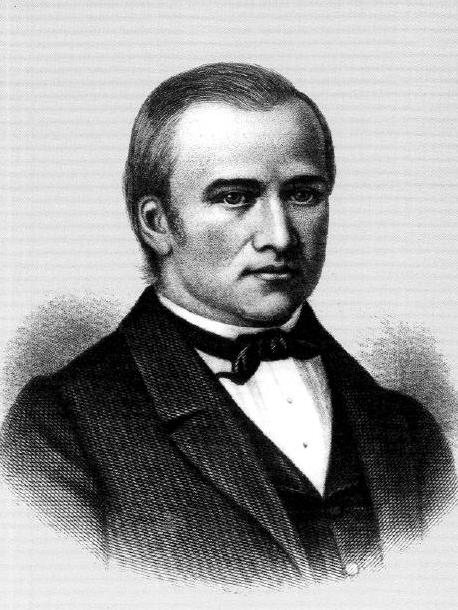
Newel K. Whitney (1795–1850) ran the principal store in Kirtland, Ohio, when the church’s missionaries arrived in November 1830. Over the next four years that store served as the bishop’s storehouse in Ohio, the Kirtland house of the United Firm, a meeting place for the School of the Prophets and, from 1832, a home for Joseph and Emma Smith.
Background
Born in February 1795 at Marlborough, Windham County, Vermont. A merchant at Plattsburgh, New York, by 1814, he clerked for A. Sidney Gilbert at Painesville, Ohio, about 1820, and had opened his own store in Kirtland by 1822. Married Elizabeth Ann Smith on 20 October 1822. By 1827 he and Gilbert were partners in N. K. Whitney & Co., and he belonged to the Reformed Baptist movement.
1830
Baptized in November by the missionaries traveling west to the Indian Territory.
1831
Appointed an agent for the church on 30 August. Ordained a high priest and appointed bishop at Kirtland in December, taking charge of the storehouse there while Edward Partridge served as bishop in Missouri.
1832
Traveled with Joseph Smith to Missouri in the spring and then on to New York City, Albany and Boston. Appointed to the United Firm in April, with his store as the firm’s mercantile house in Kirtland. Joseph and Emma Smith moved into rooms at the store that autumn.
1833
Attended the organizing meeting of the School of the Prophets on 22–23 January, held at his store.
1834
At the conference of 3 May he seconded Sidney Rigdon’s motion to change the church’s name, which passed unanimously.
Reading the record
Whitney’s place in the record is tied to a building as much as an office. His store held the goods of the Kirtland storehouse, the accounts of the United Firm and, for a time, the Smith household, so that the church’s economic arrangements in Ohio ran, quite literally, through his premises.
After 1834
He later served as a bishop at Nauvoo, Illinois, and after 1844 as a trustee for the church. He died in Salt Lake City on 23 September 1850. The Joseph Smith Papers biography covers the rest of his life.
Biographical details follow the biographical entry for Newel K. Whitney in the Joseph Smith Papers, checked against the dated documents cited on this site’s chronology pages. This page links out to primary sources rather than reproducing them at length.